Course management
Playing the Percentages, part 3: why driver usually beats laying back

On Royal Portrush's 1st, with out of bounds on both sides, our model has a 10-handicapper's driver costing 0.14 strokes a hole less than a hybrid. Part 3 of Playing the Percentages, a seven-part series on course management, covers what a missed fairway costs, where to aim away from out of bounds and when to lay back.
Out of bounds runs down both sides of the 1st at Royal Portrush, 421 yards from the championship tee, and the two lines are 70 yards apart. Rory McIlroy sent his opening drive of the 2019 Open left, past the stakes, and made 8. The course guide quoted by Golf Digest advises: “Unless against the wind, take a 3-wood or long iron for your opening tee shot.”
On the first day of the 2025 Open the field split. Shane Lowry hit driver, Matt Wallace a mini driver, Scottie Scheffler a fairway wood and McIlroy a driving iron. The hole averaged 4.295 that day and 55 per cent of tee shots found the fairway.
Seventy yards is also the width Scott Fawcett gives for a tour player’s drives over a tournament, edge to edge. He told Golf Digest in 2024 that a 10-handicapper who drives 200 yards can hit it further off line in degrees “and still have the same 70-yard-wide shot pattern”. His figure covers a tournament’s drives, more than the 20 balls part 2 uses, so it overstates a 20-ball width. For that golfer the gap between Portrush’s white stakes is no wider than the pattern, yet driver is still the right club, as the model below shows.
What a missed fairway costs
Mark Broadie, who devised strokes gained, divided tee shots on par 4s and par 5s by where they finished. On the PGA Tour, 65 per cent end on the fairway or the first cut and 31 per cent in rough or sand. Weekend golfers finish on the fairway or first cut after 49 per cent of drives and in rough or sand as often as the pros, but need a recovery shot after 16 per cent, seven times the tour rate.
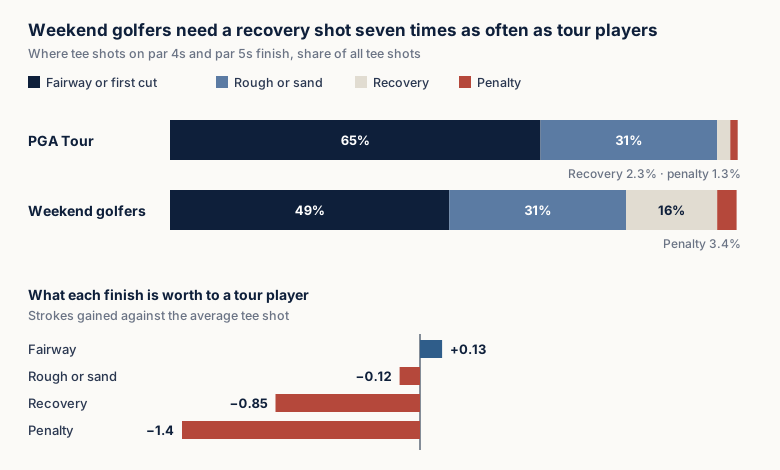 Graphic: The Head Pro. Source: Mark Broadie, GOLF.com, 3 January 2018
In ShotLink data from 2004 to 2018, analysed for the R&A and USGA’s Distance Insights project, a drive in the semi-rough cost a tour player 0.08 strokes against one on the fairway and a drive in the rough 0.28. A fairway bunker cost 0.33, lies the analysis classes as “other” 0.63, and a hazard 1.03.
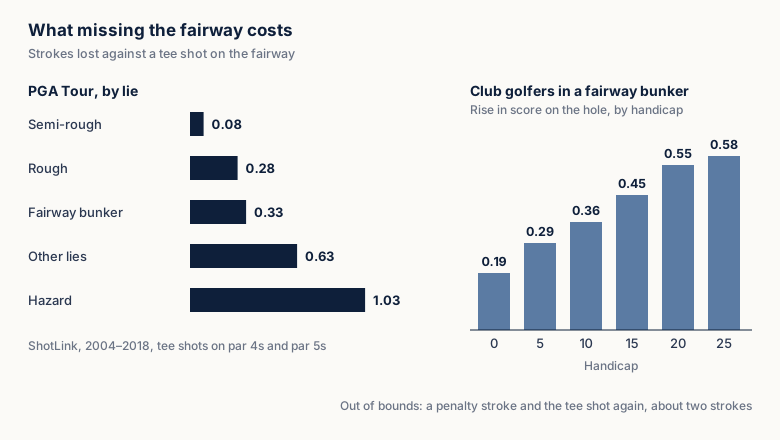 Graphic: The Head Pro. Sources: R&A and USGA, The Value of Distance (ShotLink, 2004–2018); Shot Scope via Golf Monthly, 24 July 2026
A fairway bunker raises a 25-handicapper’s score on the hole by 0.58 strokes in Shot Scope’s 2026 figures, three times what it costs a scratch player. Recovery from trees is covered in Take your medicine.
Out of bounds costs a penalty stroke and the tee shot again, about two strokes for each ball over the line. Broadie found that tour players suffer a stroke-and-distance penalty after one par-4 or par-5 tee shot in 250, about once every 18 rounds, and weekend golfers after 2.4 per cent, about one in 40, which at 14 drives a round is once every three rounds.
Twenty yards are worth more than the fairways they cost
Broadie found in 2019 that players who drove 10 yards past the PGA Tour average missed “an average of four percent more fairways”. A year earlier he had compared the tour’s ten longest drivers with its ten straightest: the long hitters gained 1.1 strokes a round from their driving and the straight hitters 0.7.
The Distance Insights analysis valued a yard of driving distance at 0.0049 strokes a hole on the PGA Tour and 0.0074 at the World Amateur Handicap Championship, an event for handicap golfers. Twenty yards are worth about 0.10 strokes a hole to a tour player and cost him about eight fairways in 100. If all eight finish in the rough at 0.28 strokes each, the loss is 0.02, against a gain of 0.10.
In Arccos data, Lou Stagner found that golfers who added 10 yards or more over one off-season cut their average score by 1.8 strokes. Shot Scope’s figures on how few extra fairways a 3-wood finds are in Driver or 3-wood?.
Driver, 3-wood or hybrid on Portrush’s 1st
We worked through the 1st at Portrush for Fawcett’s 10-handicapper, whose driver goes 200 yards with a 70-yard pattern. We assumed a 3-wood of 180 yards and a hybrid of 170, each missing by the same number of degrees, so their patterns are 63 and 59.5 yards wide; none reaches the fairway bunkers at 260 and 290 yards. We modelled each pattern as a bell curve aimed at the middle of the gap, with 20 balls spanning that width on average. No published guide gives the fairway’s width, so we assumed 30 yards, with rough out to the stakes at 0.28 strokes. A ball out of bounds costs two strokes and the drive is replayed, with the same chance of going out again, and each yard given up is charged at the amateur rate of 0.0074 strokes.
On those numbers the driver goes out of bounds 6.2 per cent of the time, the 3-wood 3.8 and the hybrid 2.8. Counting the lost yards, the driver costs 0.23 strokes against a drive on the fairway, the 3-wood 0.32 and the hybrid 0.37.
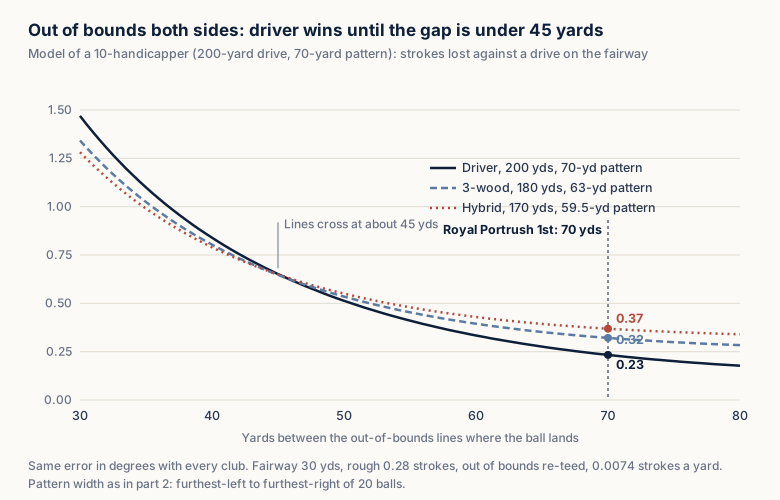 Graphic and model: The Head Pro. Sources: Golf Digest (hole layout), 15 July 2025; Scott Fawcett in Golf Digest, 1 May 2024 (pattern); R&A and USGA (value of distance, rough)
The driver stays ahead until the stakes are about 45 yards apart. Below that the extra balls out of bounds outweigh the yards, and every club costs more than half a stroke.
Shot Scope says about one amateur in ten hits a third shot from the 1st tee; its users who have played Portrush average a handicap of 11. In our model a driver pattern of about 80 yards produces that rate. With patterns of 80, 72 and 68 yards, the driver costs 0.33, the 3-wood 0.40 and the hybrid 0.43.
When the shorter club is the right one
With out of bounds from tee to green and the stakes more than about 45 yards apart, a hybrid pays only if its pattern is narrower in proportion to its length than the driver’s. With 70 yards between the stakes, our 10-handicapper’s 170-yard hybrid would need a pattern of 27 yards or less to beat the driver; with the stakes 60 yards apart, 49 yards or less. Twenty balls with each club on a launch monitor, measured as in part 2, show which side of that line you are on.
On the 7th at Augusta National, 450 yards, about 40 yards separate the trees 300 yards from the tee, and Fawcett expects tour players to keep their drives between them at least 60 per cent of the time. He prefers driver unless penalty areas are closely in play, in Golf Digest’s summary of his strategy, and says: “Dropping back to 3-wood on this hole is not going to make it any wider but dropping back to 2-iron certainly will.”
The short club wins when the trouble sits only where the driver lands, such as a burn across the fairway or bunkers just beyond the 3-wood’s reach, because laying back takes it out of play. On the 3rd at Augusta, 350 yards, it works the other way. Beside the fairway bunkers the fairway is 25 yards wide; over them, 300 yards out, the landing area is 65 yards across, and Fawcett says players will find it 95 per cent of the time with driver.
Aiming away from out of bounds on one side
More often the stakes run down one side only. Take a fairway 30 yards wide with out of bounds 25 yards left of its centre, and the same 70-yard driver pattern. Aimed at the middle of the fairway, about one drive in 11 goes out of bounds. Aimed 15 yards right, at the right edge of the fairway, the rate falls to one in 60.
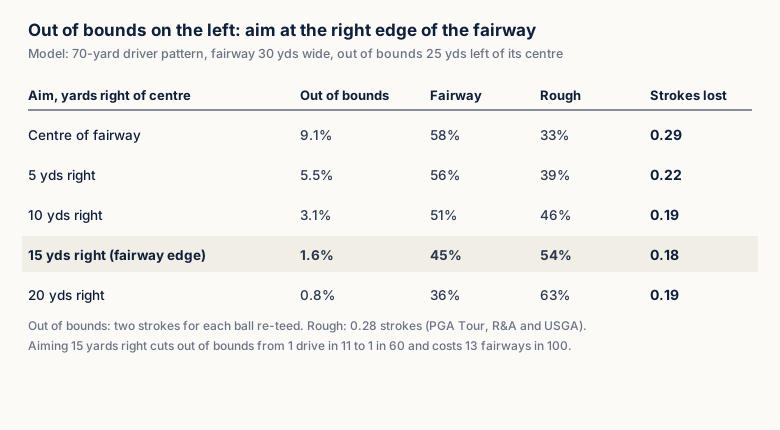 Graphic and model: The Head Pro. Rough value from R&A and USGA, The Value of Distance
Fairways hit fall from 58 in 100 to 45, but at 0.28 strokes for the rough and two for each ball re-teed the move saves 0.11 strokes a hole. Aiming 20 yards right costs 0.19, as the extra rough outweighs the out of bounds it avoids.
Next: the approach
Part 4, on Sunday 1 November, moves to the approach shot: where between the flag and the middle of the green to aim, worked through on the 13th at TPC Sawgrass with water down the left, and the distances inside which GOLFTEC’s data says the flag becomes the target.
Sources
- Golf Digest: Royal Portrush’s 1st, the hardest opening hole at the Open (Jamie Kennedy), 15 July 2025
- ESPN: Hole No. 1 at the Open Championship, Royal Portrush
- GOLF.com: The unique, throwback reason Royal Portrush’s opening hole has internal out of bounds (Josh Berhow), 18 July 2019
- Today’s Golfer: How amateur golfers fare at Royal Portrush (Shot Scope data)
- Golf Digest: Course-management expert Scott Fawcett knows how we can all play smarter golf (Drew Powell), 1 May 2024
- Golf Digest: 5 shots that players should never hit at Augusta National (Drew Powell)
- GOLF.com: The pros save strokes by “missing” tee shots in the right places (Mark Broadie), 3 January 2018
- GOLF.com: Bomb-and-gouge? Why driving distance is so valuable (Mark Broadie), 15 August 2018
- GOLF.com: Advanced stats prove who the best driver on Tour is (Mark Broadie), 27 August 2019
- R&A and USGA: Distance Insights, The Value of Distance
- Golf Monthly: How many shots do amateur golfers lose when finding a bunker? (Shot Scope), 24 July 2026
- GOLF.com: New study reveals how much 10 yards help (Lou Stagner, Arccos), 17 August 2022
Spotted an error? Tell us and we will fix it. Our editorial standards.


