Course management
Playing the Percentages, part 1: let your shot pattern set the target

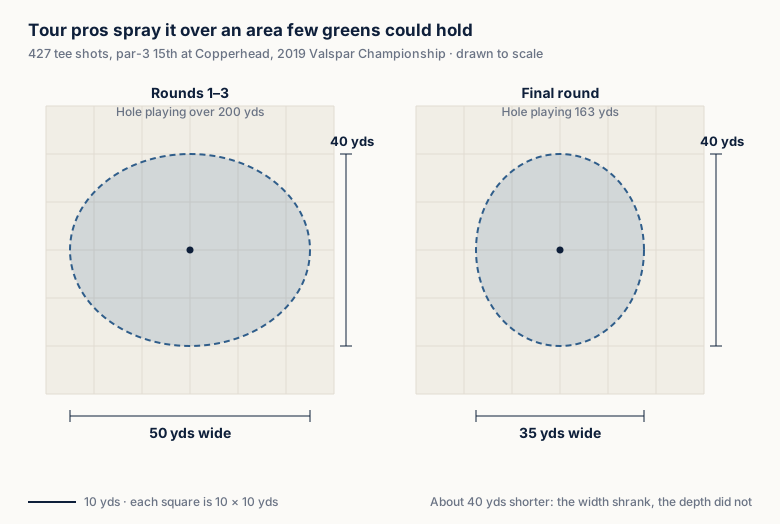
Tour pros spread a 163-yard tee shot over 35 by 40 yards. Part 1 of Playing the Percentages, a seven-part series on course management, covers shot patterns and expected score.
At the 2019 Valspar Championship, 427 tee shots were hit into the par-3 15th on Innisbrook’s Copperhead course. When the hole played over 200 yards for the first three rounds, the balls landed across an area roughly 50 yards wide and 40 yards deep. For the final round it was cut to 163 yards. The pattern narrowed to about 35 yards wide and stayed 40 yards deep.
Scott Fawcett, who built the DECADE course-management system used by tour players and more than 100 US college programmes, published those numbers to make a point about aiming. The best iron players in the world, presumably firing at the pin from 163 yards, still spread the ball over an area few greens could hold. If they cannot keep it tighter than that, he argued, less-skilled players should never aim at the flag.
 Graphic: The Head Pro. Source: Scott Fawcett, GOLF.com, 11 November 2019
This series, Playing the Percentages, works through course management in seven parts, from tee to green, ending with a hole-by-hole plan for your own course. It starts with how shots scatter.
Every club has a shot pattern
Hit a hundred balls with the same club at the same target and they spread across an oval. Each swing sends one pellet out of a shotgun: you choose where the barrel points, and chance decides where that pellet lands inside the pattern.
 Tiger Woods at Congressional Country Club, Bethesda, in 2009. Photo: Tim Hipps / US Army, public domain
The pattern grows with distance. Fawcett describes it as a triangle: the same error in degrees produces a wider spread the further the ball travels. Across a typical event, he says, about 70 yards separate a tour player’s furthest-left and furthest-right drives. That is wider than most fairways, and driver is still usually the right club off the tee. Part 3 explains why.
Where a 90-shooter’s approaches finish
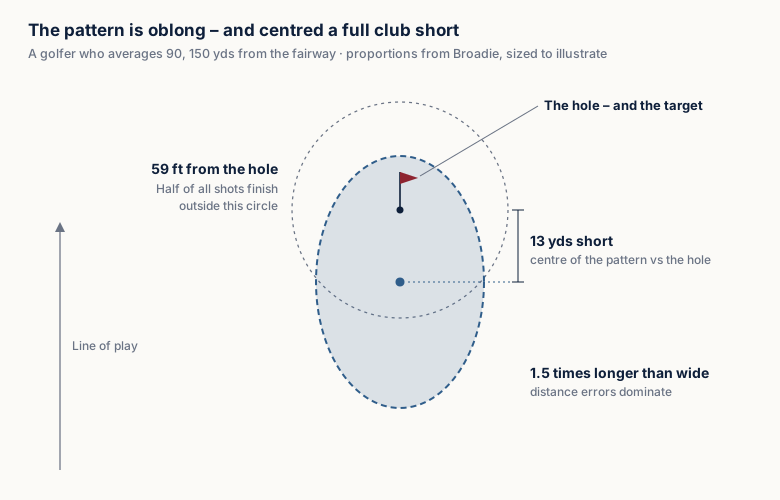
Mark Broadie, whose strokes-gained statistics the PGA Tour adopted in 2011, has also collected amateur shot data at Columbia. From 150 yards in the fairway, a golfer who averages 90 finds the green 35 per cent of the time. Half of all approaches from there finish more than 59 feet from the hole, two and a half times further than a tour pro from the same spot.
The pattern is oblong, 50 per cent longer than it is wide, and its centre sits about 13 yards short of the hole, roughly a full club.
 Graphic: The Head Pro. Proportions from Mark Broadie, GOLF.com, 2 January 2015
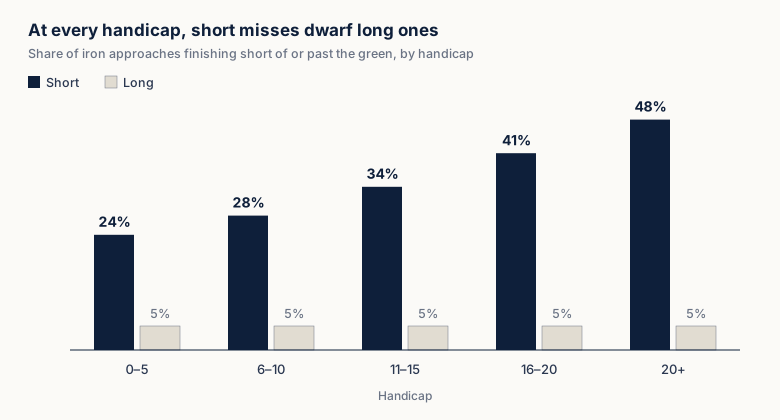
Arccos data on UK club golfers points the same way. Players off 20 or higher left 48 per cent of their iron approaches short of the green and hit only 5 per cent long; the 5 per cent figure held at every handicap. We set out the fix for the short miss in Take one more club; here the figures show that the pattern is lopsided before you choose a target.
 Graphic: The Head Pro. Source: Arccos data via Today’s Golfer
Broadie also found that the same 90-shooter’s pattern from 150 yards is much tighter and rounder from a par-3 tee than from the fairway, which he puts down to better club selection on the tee and the benefit of a peg. He tells golfers to tee it up on every par 3.
What an average shot looks like
Lou Stagner, a statistician who analyses Arccos data, compared tour players and scratch golfers from 150 yards in the fairway.
| From 150 yds, fairway | Tour pro | Scratch |
|---|---|---|
| Greens hit | 76.1% | 61.0% |
| Average proximity | 25 ft 3 in | 36 ft 8 in |
| When on the green | 20 ft 11 in | 23 ft 9 in |
| When missing the green | 38 ft 9 in | 60 ft 1 in |
Scratch golfers, fewer than one in a hundred players by Stagner’s count, hit the green from there just over six times in ten. For a 15-handicapper, he says, a 150-yard approach that finishes on the apron 19 yards from the hole is exactly average: it neither gains nor loses strokes against their expected score. For a 20-handicapper the average finish is 23 yards away.
Stagner’s argument is that a golfer who overrates their game picks targets they cannot handle, and one who is annoyed by every average shot makes worse decisions for the rest of the round.
Expected score, worked through
If every shot comes from a pattern, the decision over the ball is where to point that pattern so the average score is lowest. Working that out needs expected score: the average number of strokes a golfer of a given standard takes to hole out from any spot.
From more than eight million PGA Tour shots, Broadie calculated that a pro needs 2.85 strokes from 120 yards in the fairway and 3.08 from the rough at the same distance, so the rough costs the best part of a quarter of a shot. On the green, pros average two putts from 33 feet. A 90-shooter averages two putts from 19 feet.
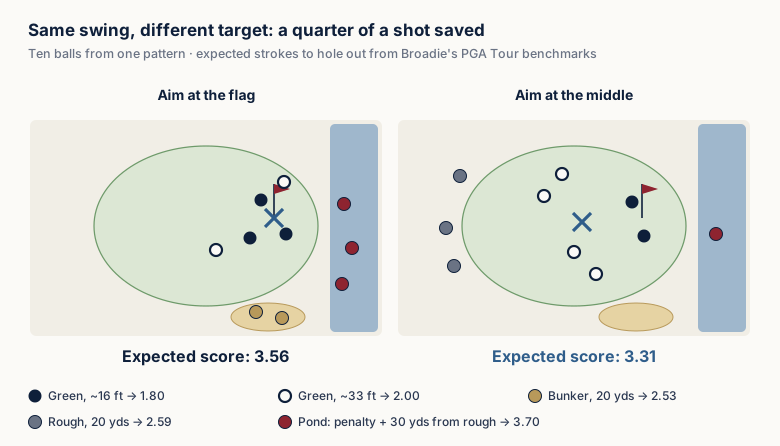
Picture a green with a pond down the right, a bunker at the front right and the flag tucked towards the water. Take ten balls from the same pattern, first aimed at the flag, then at the middle of the green. The scatter is illustrative; the value of each spot comes from Broadie’s PGA Tour benchmarks.
 Graphic: The Head Pro. Values from Table B.1 in Broadie, Interfaces (2012), PGA Tour 2003–2010; ball positions illustrative
Aimed at the flag, five balls finish on the green, three of them close, but three find the pond and two the bunker. The average is 3.56 strokes to hole out. Aimed at the middle, six balls stay on the green, most of them further away, three finish in the left rough and one in the water. The average falls to 3.31.
That is a quarter of a shot gained with the same swing. Face that decision four times in a round and a full stroke is at stake. These are tour benchmarks; an amateur’s pattern is wider and every trip into trouble costs more.
Fawcett frames it as a bet. If you won $10 for every ball that finished on the green and paid $20 for every one that missed or found trouble, you would aim at the middle.
He also points out that the middle is quite often a less effective target than the flag, and that the best aim point usually sits between the two, depending on where the trouble is, the size of the green and the width of your pattern. Part 4 works through those cases; our fat-side rule covers the most common one.
Misses inside and outside the pattern
A 7-iron that finishes 10 yards right of target is not a mistake for a golfer whose 7-iron pattern is 30 yards wide. Changing your swing mid-round because of it fixes nothing. The topped shot that scuttles 50 yards, or the one that shoots right off the hosel, falls outside the pattern. No aim point protects you from those; they are a job for the range.
Patterns also differ by club. In the Arccos data, amateurs tend to miss right with long irons and left with short irons and wedges, so one aim point may not suit every club in the bag. Memory misleads too: the golfer who remembers a 7-iron flying 160 yards on a still July evening reaches for it from 155 in October, and the ball finishes in the front bunker.
Four rules for choosing a target
- Check where the bad shots go. Before choosing a target, ask where your misses finish if you aim there. If the answer is water, sand or out of bounds, move the target.
- Club for your average strike. Pick the club that gets your average shot at least to the middle of the green.
- Tee it up on par 3s. By Broadie’s numbers it tightens the pattern.
- Commit to the target. Fawcett’s advice is to pick a sensible target, which is rarely the flag, and then try to hit it. If you miss, the pattern usually leaves you somewhere respectable.
Next: measuring your own pattern
All of this depends on knowing how big your pattern is, and Stagner’s data suggests most golfers think it is smaller than it is.
Stagner has worked out how close golfers of different standards need to be to average the same number of strokes to hole out. A scratch golfer from 150 yards in the fairway is level with a 20-handicapper who has just 27 yards left. The scratch golfer, in turn, matches a tour pro hitting from about 205 yards. Part 2 shows how to map your own dispersion with a launch monitor, on-course tracking or a pencil and a scorecard, and how to tell a pattern from bad luck.
Sources
- GOLF.com: Mark Broadie, Improving your approach shots is the fastest way to lower scores
- Mark Broadie: Assessing Golfer Performance on the PGA TOUR, Interfaces (2012)
- GOLF.com: Scott Fawcett, According to this surprising study, here’s where you should never aim
- Golf Digest: Course-management expert Scott Fawcett knows how we can all play smarter golf
- Today’s Golfer: Ironplay, where amateurs go wrong (Arccos data)
- GOLF.com: This stat proves you should manage your own expectations (Lou Stagner)
- Today’s Golfer: The ultimate golf strategy guide (Lou Stagner)
- Hack It Out Golf: Handicap skill tiers by the numbers (Lou Stagner), 30 July 2026
- Golf365: How hard is it to become a scratch golfer?
Spotted an error? Tell us and we will fix it. Our editorial standards.


