Course management
Playing the Percentages, part 4: how far from the flag to aim

On the 13th at TPC Sawgrass, a golfer who averages 90 does best aiming 11 yards right of a flag cut near the water, past the middle of the green; a pattern 2.5 times narrower aims 3 yards right. Part 4 of Playing the Percentages, a seven-part series on course management, covers how the trouble, the green and your pattern set the aim point.
The 13th on the Stadium Course at TPC Sawgrass is 156 yards from the blue tees and 181 from the tee the PGA Tour uses at the Players Championship. Water runs down the entire left side of the hole, and the left of the green slopes sharply towards it. The green is 28 yards deep, according to the club’s yardage guide.
With a flag cut on the left, 5 yards from the edge, the 13th raises the question part 1 left open: how far right of the flag to aim. Scott Fawcett, whose DECADE system Bryson DeChambeau has used to choose targets, told Golf Digest in 2024 that “there’s an inflection point between aiming at the flag and at the middle of the green that is optimal”. We worked out where that point sits on the 13th for two golfers.
A model of the 13th
The yardage guide does not give the green’s width, so we assumed 25 yards, the average GOLFTEC uses for its targeting data. The green is drawn as an oval 28 yards deep and 25 wide, with the water starting 3 yards beyond the left edge and rough everywhere else. A ball in the water costs a penalty stroke and leaves a 30-yard pitch from the rough, the convention we used for the pond in part 1.
The first golfer averages 90. We fitted that golfer’s pattern to the three numbers Mark Broadie gave GOLF.com in 2015 for approaches from 150 yards (a median finish of 59 feet, a pattern half as long again as it is wide, a centre 13 yards short) and applied it at 156 yards. Broadie’s pattern is for shots from the fairway; part 1 noted that from a par-3 tee the same golfer’s pattern is tighter and rounder, so on the 13th this is the wider case. The second pattern is 2.5 times smaller in both width and depth and centred on the target, the gap Broadie found between a 90-shooter’s and a tour pro’s median finish from 150 yards.
Every finishing spot is valued with Broadie’s PGA Tour benchmarks, from Table B.1 of his 2012 paper in Interfaces for the rough and the tour putting table for the green. An amateur needs more strokes from the same spots, so the model understates what the water costs a 90-shooter.
How wide the two patterns are
Two-thirds of the 90-shooter’s tee shots finish inside an oval 34 yards wide and 51 deep. The narrower pattern’s oval is 14 yards wide and 20 deep.
Part 2 measures width differently, from the furthest-left to the furthest-right of 20 balls. On average, 20 balls from the 90-shooter’s pattern span 43 yards from side to side, and 20 from the narrower pattern span 17. A golfer whose 20-ball width is around 40 yards with the club they hit 150 yards is close to the first pattern.
Three aim points for the 90-shooter
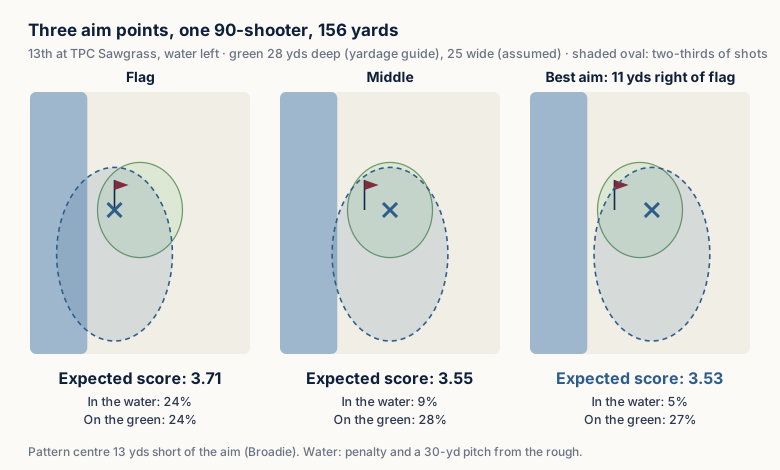 Graphic: The Head Pro. Hole from the TPC Sawgrass yardage guide, 2025; pattern from Broadie, GOLF.com, 2 January 2015; values from Broadie, Interfaces, 2012. Green width assumed
Aimed at the flag, 24 per cent of the 90-shooter’s tee shots finish in the water and the expected score is 3.71. Aimed at the middle of the green, 7.5 yards right of the flag, the water takes 9 per cent and the average falls to 3.55. The best aim point is 11 yards right of the flag, 3.5 yards past the middle, where 5 per cent go in the water and the expected score is 3.53.
Moving from the middle to the best aim saves only another 0.02 strokes, and beyond 11 yards the cost rises again as more balls finish in the rough right of the green. From the three aims, 24 to 28 per cent of tee shots find the green, below the 35 per cent Broadie reports from 150 yards, because the model’s green is a small oval and the pattern’s centre is 13 yards short.
The narrower pattern aims 3 yards right of the flag
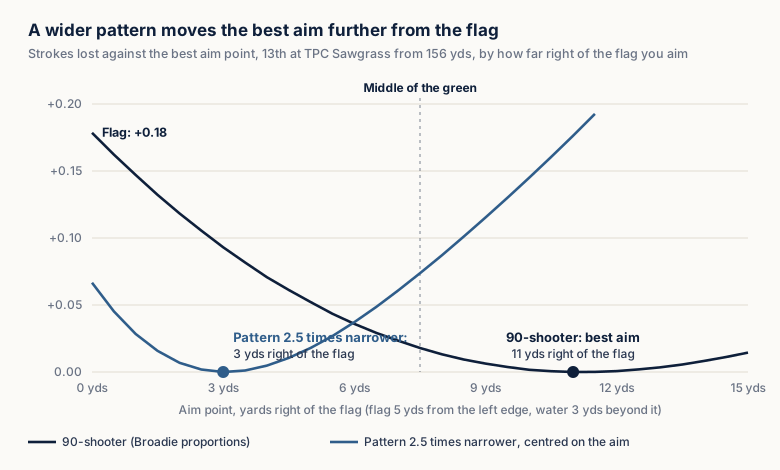 Graphic: The Head Pro. Same model as above; narrower pattern scaled from Broadie, GOLF.com, 2015
Tested half a yard at a time, the narrower pattern’s best aim is 3 yards right of the flag. Aiming at the flag costs it 0.07 strokes against that spot, and the middle of the green slightly more: from there 93 per cent of tee shots find the green, but the putts are longer.
The table changes one part of the model at a time.
| Change to the model | Best aim, 90-shooter | Best aim, narrower pattern |
|---|---|---|
| As drawn: water left, green 25 yds wide | 11 yds right of flag | 3 yds right of flag |
| Green 20 yds wide | 11 yds right | 3 yds right |
| Green 30 yds wide | 12 yds right | 3 yds right |
| Rough instead of water on the left | 3 yds right | 2.5 yds right |
Replace the water with rough and the 90-shooter’s best aim moves to 3 yards right of the flag, and aiming straight at it costs less than a hundredth of a stroke. The size of the green barely changes the answer.
Red lights and the 5 per cent rule
DECADE sorts flags by the danger around them. A red light is a flag “short-sided by water”, in CaddieHQ’s summary of the system, and for every red or yellow light the target is the centre of the green.
On the 13th that rule suits the 90-shooter, for whom the middle costs 0.02 strokes against the best aim and the flag 0.18. It is too cautious for the narrower pattern, which loses slightly more aiming at the middle than aiming at the flag.
A DECADE handout posted on the USGA’s US National Development Program pages gives a finer rule that fits the narrower pattern. Take 5 per cent of the yardage and aim at least that far from the edge the flag is near; if the flag is further in than that, aim at it. From 156 yards, 5 per cent is 7.8 yards, so the target is 2.8 yards right of a flag 5 yards from the edge, almost exactly the model’s best aim. For the 90-shooter the same rule puts 17 per cent of tee shots in the water and costs 0.10 strokes against the best aim.
One more club on the 13th
The centre of the 90-shooter’s pattern sits 13 yards short of where it is aimed. Broadie puts that at roughly one club, so taking one more puts the centre of the pattern on the target. On the 13th that raises the share of tee shots finishing on the green from 27 per cent to about 35 per cent at the best aim and cuts the expected score by about 0.07, whichever aim is chosen. The best aim barely moves, to 10.5 yards right of the flag, and with one more club it averages 3.47, a quarter of a shot better than aiming at the flag with the club that reaches it on a good strike. Why most misses finish short is covered in our one-more-club rule.
When the flag is the target
GOLFTEC used its students’ approach shots and an average green about 25 yards wide to work out how close each standard of golfer has to be before the flag becomes the target. Nick Clearwater, its vice-president of instruction, set out the figures in GOLF.com in 2021.
| Typical score | Aim at the flag from |
|---|---|
| 100 or more | 25 yds and in |
| 90s | 100 yds and in |
| 80s | 135 yds and in |
| PGA Tour | 172 yds and in |
“Even a PGA Tour pro should take caution when aiming at the pin outside 172 yards,” Clearwater wrote. From 156 yards on the 13th, only the tour player is inside the distance, and the model’s narrower pattern still aims 3 yards right of a flag cut 5 yards from the edge.
Next: around the green
Part 5, on Sunday 8 November, covers the shots around the green: which club to chip with, why the first job is getting the ball on the green, how to play greenside bunkers, and where to leave the first putt.
Sources
- TPC Sawgrass: THE PLAYERS Stadium Course yardage guide (2025)
- THE PLAYERS: Stadium Course, hole by hole
- Today’s Golfer: TPC Sawgrass hole 13
- GOLF.com: Mark Broadie, Improving your approach shots is the fastest way to lower scores, 2 January 2015
- Mark Broadie: Assessing Golfer Performance on the PGA TOUR, Interfaces (2012)
- The DIY Golfer: Strokes gained putting explained (PGA Tour putting benchmark)
- Golf Digest: Course-management expert Scott Fawcett knows how we can all play smarter golf, 1 May 2024
- Golf Digest: Has this data nerd created a golf cheat code? (Bryson DeChambeau on DECADE)
- CaddieHQ: How to use DECADE golf
- USGA, US National Development Program: Picking targets into greens
- GOLF.com: Nick Clearwater (GOLFTEC), This handy chart tells you when you should go pin seeking, 31 March 2021
Spotted an error? Tell us and we will fix it. Our editorial standards.


